
BAMS College in Bihar – JP Institute of Ayurveda & Medical Sciences
If you are searching for a BAMS College in Bihar, choosing the right institution is about much more than finding a college name on a list. A BAMS student spends years developing knowledge of Ayurveda, anatomy, physiology, pharmacology, clinical subjects and practical healthcare, so the quality of academic teaching and clinical exposure can make a meaningful difference to the learning experience. For students and parents looking for an Ayurvedic medical college in Bihar, JP Institute of Ayurveda & Medical Sciences in Patna offers an option that brings academic education, Ayurvedic healthcare and hospital-based learning together. The institute’s website identifies its academic wing, Ayurvedic hospital and pharmacy as key components of its educational model, while its published information highlights departments such as Samhita Siddhant, Rachana Sharir, Kriya Sharir, Dravyaguna, Panchakarma and Kaya Chikitsa.
Table of Contents
- Why Choose a BAMS College in Bihar?
- Growing Interest in Ayurvedic Medical Education
- JP Institute of Ayurveda & Medical Sciences, Patna
- A Recognized Ayurvedic Institution in Bihar
- BAMS Course at JP Institute of Ayurveda
- What Students Learn During BAMS
- BAMS Admission in Bihar
- NEET-UG and Bihar AYUSH Counselling
- BAMS Eligibility Criteria
- BAMS Course Duration and Academic Structure
- Clinical Training and Ayurvedic Hospital Facilities
- 100-Bed Hospital and Practical Exposure
- Departments and Academic Learning
- Ayurvedic Pharmacy and Herbal Learning
- Why JP Institute Can Be a Strong Choice
- BAMS College in Patna for Students Across Bihar
- BAMS Admission 2026: What Students Should Check
- BAMS Fees, Seats and Admission Information
- How to Select the Right BAMS College in Bihar
- JP Institute vs Other BAMS Options in Bihar
- Career Opportunities After BAMS
- Documents Required for BAMS Admission
- Frequently Asked Questions About BAMS College Bihar
- Conclusion
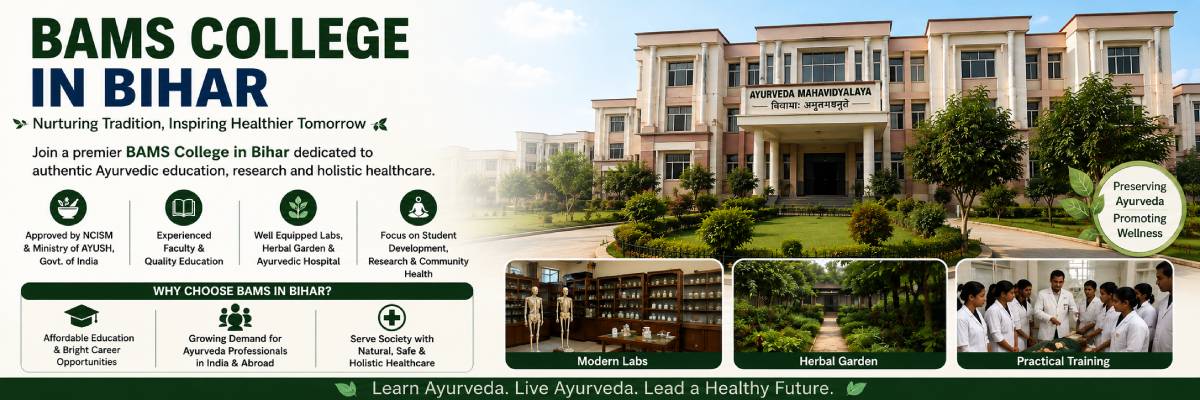
The institute is located in Sarai Danapur, Patna, Bihar, and its official website currently provides admission-related information, BCECE Board counselling links, NCISM-related documentation and details of its facilities. NCISM’s published material also lists J.P. Institute of Ayurvedic & Medical Sciences, Sattar, Panchmahuni, Sarai Maner, Patna, Bihar, under institute ID AYU0835 and records permission for the UG BAMS course. For students evaluating a BAMS College in Bihar, these regulatory and institutional details are important because prospective students should always verify the current permission, affiliation, seat intake and counselling information before making an admission decision. This page is designed to answer those questions in a straightforward way while helping students understand what they should look for when comparing Ayurvedic colleges in Bihar.
Why Choose a BAMS College in Bihar?
Bihar has a long association with traditional knowledge, education and healthcare, making it a natural state for students interested in Ayurveda. For a student who wants to pursue a medical education pathway while studying the principles and clinical applications of Ayurveda, a BAMS College in Bihar can provide the advantage of studying closer to home while remaining connected to the state’s growing healthcare ecosystem. Patna, in particular, is an important educational centre and offers students access to transportation, healthcare institutions, coaching resources and a wider urban environment. Instead of viewing college selection simply as a question of location, students should consider the complete academic ecosystem: regulatory status, teaching faculty, hospital exposure, laboratories, departments, infrastructure, student support, admission transparency and practical training. These factors together determine whether an institution provides an environment in which a student can build both theoretical understanding and clinical confidence. JP Institute’s website describes a model combining Ayurvedic education with a hospital and pharmacy, which is particularly relevant for students who want their academic learning connected with practical healthcare exposure.
Growing Interest in Ayurvedic Medical Education
The interest in Ayurveda has expanded beyond traditional wellness into formal medical education, research and clinical practice. BAMS, or Bachelor of Ayurvedic Medicine and Surgery, is an undergraduate medical programme governed within India’s Indian System of Medicine regulatory framework. The National Testing Agency’s current NEET-UG information explicitly states that NEET-UG is applicable for undergraduate BAMS admissions in medical institutions governed by the National Commission for Indian System of Medicine Act. This means students considering a BAMS College in Bihar should approach admission with the same seriousness they would apply to any professional medical programme: understand eligibility, qualify through the required entrance route, follow the appropriate counselling process and verify institutional information through official sources. Bihar’s official BCECE Board currently maintains a dedicated UGMAC(AYUSH)-2026 section, showing that AYUSH undergraduate counselling is being handled through the state counselling system.
JP Institute of Ayurveda & Medical Sciences, Patna
JP Institute of Ayurveda & Medical Sciences is situated at Neoraganj, Tikaitpur Road, near Shivala Chowk, Sarai Danapur, Patna, Bihar. The institute’s official website describes its mission as providing Ayurvedic education while connecting traditional knowledge with modern scientific approaches and research. Its campus model includes an Ayurvedic institute, a hospital and an Ayurvedic pharmacy, giving students access to different dimensions of Ayurvedic education. For anyone searching online for a BAMS College in Bihar, the combination of these three components deserves attention because Ayurveda is not learned effectively through textbooks alone. Students need opportunities to understand classical concepts, identify medicinal plants and substances, observe clinical procedures, communicate with patients and understand how theoretical principles are applied in healthcare settings.
The institute’s website states that its Ayurvedic hospital is a 100-bed speciality hospital and lists OPD, IPD, clinical laboratory, operation theatre, labour room, Panchakarma centre, NICU and emergency facilities among its infrastructure. Clinical infrastructure is particularly relevant when comparing a BAMS College in Bihar, because exposure to real patients and healthcare workflows can help students connect classroom subjects with practical medicine. Prospective students should still verify current operational facilities, permitted intake, affiliation and applicable regulatory requirements directly with the institution and relevant authorities before admission. The goal of this page is not to suggest that one college is automatically suitable for every student, but to give applicants a useful framework for making a more informed comparison.
A Recognized Ayurvedic Institution in Bihar
Regulatory verification should be one of the first checks made by anyone searching for a BAMS College in Bihar. NCISM publishes information relating to Ayurveda colleges and permissions, and its records include JP Institute of Ayurvedic & Medical Sciences in Bihar. The NCISM permission documentation identifies the institution as a private Ayurveda college and records its UG BAMS permission history. The institute itself also provides a dedicated section for NCISM mandates, permission letters, faculty information, student details, clinical material and other institutional information. This transparency is useful for applicants because college claims should ideally be checked against primary regulatory and counselling sources rather than relying only on third-party education portals or promotional listings.
BAMS Course at JP Institute of Ayurveda
BAMS is designed for students who want to study Ayurveda as a structured medical discipline. The curriculum combines classical Ayurvedic principles with subjects related to the human body, medicinal substances, diagnosis, treatment and clinical practice. At JP Institute, the published department structure includes Samhita Siddhant, Rachana Sharir, Kriya Sharir, Dravyaguna, Panchakarma and Kaya Chikitsa, giving students exposure to important areas of Ayurvedic education. When evaluating a BAMS College in Bihar, students should look beyond a course name and examine whether the college provides access to the departments, faculty, laboratories, hospital services and practical learning environment needed to support the curriculum.
A strong BAMS education should gradually move students from foundational concepts to applied clinical understanding. Early academic learning may focus heavily on principles, anatomy, physiology, Sanskrit terminology and classical texts, while later study becomes increasingly connected to diagnosis, medicine and clinical procedures. This progression is similar to constructing a building: the classical foundations may not always be visible once the structure is complete, but without them the later clinical understanding has nothing stable to rest upon. For students considering a BAMS College in Bihar, this is why department-wise teaching, practical sessions and hospital exposure deserve as much attention as the college’s campus appearance or promotional claims.
What Students Learn During BAMS
Students pursuing BAMS study Ayurveda’s classical knowledge alongside subjects that help them understand the human body and clinical practice. JP Institute’s published department information identifies Rachana Sharir with anatomy-related learning, Kriya Sharir with normal physiological functions, Dravyaguna with medicinal substances and Panchakarma with therapeutic procedures. Kaya Chikitsa is presented as the Ayurvedic branch concerned with general medicine. Such subject diversity means that students looking for a BAMS College in Bihar should expect the course to require consistent academic effort rather than treating Ayurveda as a purely theoretical wellness subject.
The practical side of BAMS is equally important. Students need to develop the ability to understand patients, observe clinical conditions, connect symptoms with Ayurvedic principles and learn appropriate therapeutic approaches under qualified supervision. An attached hospital can support this transition by exposing students to OPD and IPD environments and different aspects of patient care. JP Institute’s website specifically describes OPD, IPD, diagnostic, Panchakarma and emergency-related infrastructure within its hospital facilities. Students and parents should ask the college about the actual schedule and extent of clinical teaching before enrolling, because the presence of a hospital building and the quality of student clinical exposure are related but not identical questions.
BAMS Admission in Bihar
For students planning admission to a BAMS College in Bihar, the first major point to understand is the role of NEET-UG. The official NTA website states that NEET-UG is the common entrance examination applicable to undergraduate BAMS, BUMS and BSMS programmes under the relevant Indian System of Medicine framework. After qualifying through the applicable entrance process, candidates must follow the counselling requirements of the relevant authority. Bihar’s BCECE Board currently publishes a dedicated UGMAC(AYUSH)-2026 portal and notices for AYUSH counselling.
The basic admission journey therefore involves more than simply contacting a college and paying a fee. Students should monitor official NEET information, check the Bihar counselling notification, register within the prescribed period, complete choice filling correctly and follow the seat-allotment and document-verification instructions. JP Institute’s website currently links to the BCECE Board and publishes counselling-related information, but students should always treat the latest official counselling notice and prospectus as the final authority. If a student is searching for a BAMS College in Bihar with the intention of joining in 2026, checking official notices should be part of the admission checklist.
NEET-UG and Bihar AYUSH Counselling
The current 2026 NEET information is especially important for applicants because admission rules and counselling schedules can change from one academic session to another. NTA’s official 2026 portal currently contains the NEET-UG 2026 information bulletin, result information and other official notices. Bihar’s BCECE Board also currently lists UGMAC(AYUSH)-2026 notices. Consequently, a student should not rely on an old blog claiming a particular cutoff, counselling date or admission procedure without checking the latest official notification.
BAMS Eligibility Criteria
Eligibility for BAMS admission should always be checked against the current official prospectus and applicable regulatory rules rather than copied from an old educational website. In general, applicants should carefully verify the required Class 12 subjects, qualifying examination requirements, age conditions and NEET eligibility applicable to their admission year. The exact rules can change, and category-specific provisions may also apply. A student who wants to join a BAMS College in Bihar should therefore keep their academic certificates, identity documents, category documentation where applicable and entrance examination records ready well before counselling begins.
This is also an area where prospective students should be cautious about unofficial promises. No responsible college-selection strategy should be based solely on a claim such as “guaranteed admission” or an old cutoff. Instead, students should compare the current counselling rules, seat matrix, permitted intake and their own NEET performance. The official BCECE Board itself cautions applicants that information on its website is for guidance and that officially authorized information should be obtained from the prospectus. That principle is useful for every applicant researching a BAMS College in Bihar.
BAMS Course Duration and Academic Structure
BAMS is a professional undergraduate medical education programme that requires sustained study over multiple academic years, followed by the applicable internship and clinical requirements. Students should therefore choose their institution with a long-term perspective rather than making a decision based only on first-year convenience. The course involves theoretical subjects, practical learning, clinical exposure and professional development, so attendance, disciplined study and participation in clinical activities are essential. When evaluating a BAMS College in Bihar, prospective students should ask how the college organizes academic teaching, practical classes, hospital postings, examinations and internship support.
The academic structure of Ayurveda also has a distinctive character because students engage with classical texts and concepts while learning contemporary scientific approaches relevant to medical education. JP Institute’s stated objective is to connect Ayurveda’s traditional knowledge with modern scientific help and research. This combination can be particularly valuable for students who want to understand Ayurveda as a structured healthcare discipline rather than as a collection of isolated remedies. The right BAMS College in Bihar should encourage students to develop both respect for classical knowledge and the ability to approach healthcare with observation, evidence, discipline and professional responsibility.
Clinical Training and Ayurvedic Hospital Facilities
Clinical exposure is one of the most important factors to examine when comparing a BAMS College in Bihar. A medical student learns differently when a textbook concept is followed by an opportunity to observe how patients are assessed and managed in a real healthcare setting. JP Institute states that its Ayurvedic Hospital has 100 beds and includes OPD, IPD, clinical laboratory, operation theatre, labour room, Panchakarma, NICU and emergency facilities. For BAMS students, such infrastructure can provide a broader environment in which classroom concepts can be connected with patient-care situations.
Students should nevertheless ask practical questions before admission. How frequently are students posted to clinical departments? How is supervision arranged? What kind of patient exposure is available? Which procedures can students observe or assist with under supervision? These questions are more meaningful than simply asking whether a college has a “hospital.” A good BAMS College in Bihar should be evaluated on the depth and organization of clinical education as well as the existence of physical infrastructure.
100-Bed Hospital and Practical Exposure
JP Institute’s official website identifies its hospital as a 100-bed speciality Ayurvedic hospital and research centre. The institute also lists multiple clinical facilities, including OPD, IPD, laboratory, Panchakarma and emergency-related services. These facilities can form an important part of the learning environment because students can see how different hospital functions interact. For an aspiring Ayurvedic physician, learning to communicate with patients, understand clinical documentation, observe procedures and work within a healthcare team can be just as important as memorizing theoretical information.
A student comparing a BAMS College in Bihar should therefore evaluate hospital exposure using evidence rather than marketing language. Ask for details about departments, patient services, teaching schedules and clinical postings. Parents can also request information about faculty supervision and student participation. These practical questions help distinguish between a college that simply advertises hospital infrastructure and an institution where the hospital is meaningfully integrated into medical education.
Departments and Academic Learning
JP Institute publishes several Ayurvedic departments on its official website, including Samhita Siddhant, Rachana Sharir, Kriya Sharir, Dravyaguna, Panchakarma and Kaya Chikitsa. Each area contributes to a different part of a student’s education. Samhita Siddhant introduces foundational Ayurvedic principles and classical knowledge, Rachana Sharir develops understanding of anatomy, Kriya Sharir addresses normal body functions, Dravyaguna focuses on medicinal substances, Panchakarma covers therapeutic procedures and Kaya Chikitsa addresses general medicine within Ayurveda.
For students looking for a BAMS College in Bihar, department availability matters because it indicates the breadth of the academic environment. It also gives prospective students a useful starting point for understanding what they will study. Instead of selecting a college solely because its name appears in search results, applicants should visit its official website, examine departmental information and ask for current faculty and academic details. A thoughtful comparison can reveal differences that are invisible in short college listings.
Ayurvedic Pharmacy and Herbal Learning
Ayurvedic education has a strong connection with medicinal plants, herbs and formulation principles. JP Institute identifies an Ayurvedic pharmacy as one of its three core institutional components, alongside the institute and hospital. This can support practical understanding of Ayurvedic medicines and help students connect subjects such as Dravyaguna with real-world preparation and dispensing processes. Students considering a BAMS College in Bihar should look at whether the institution provides opportunities to understand medicinal plants, raw materials, formulations, quality considerations and the professional responsibilities associated with Ayurvedic medicines.
The educational value of pharmacy and herbal learning lies in connecting theory with observation. A student may study the properties of a medicinal substance in class, but seeing materials, understanding identification and learning how formulations are prepared can make that knowledge much more memorable. When combined with clinical learning, this creates a more complete picture of Ayurveda. For a student who is genuinely interested in becoming an Ayurvedic medical professional, these practical components should be considered alongside classroom teaching.
Why JP Institute Can Be a Strong Choice
There are several factors students can examine when considering JP Institute among the available options for a BAMS College in Bihar. The institute is located in Patna, operates an Ayurvedic hospital and pharmacy, publishes NCISM-related information, provides departmental information and maintains links to Bihar’s counselling system. NCISM’s published records also include the institution in Bihar and document its permission history for the UG BAMS programme. These are useful starting points for students who want to research the institution through primary sources.
The institute also positions itself around the combination of Ayurvedic tradition and modern healthcare infrastructure. Its website describes more than two decades of experience and highlights its hospital-based facilities and academic departments. Students should independently verify the latest admission information, fee structure, seat intake and regulatory status before committing. Still, for someone searching for a BAMS College in Bihar, JP Institute provides several of the elements that are sensible to investigate in a serious college comparison.
BAMS College in Patna for Students Across Bihar
Patna is an important consideration for students from different districts of Bihar because of its educational ecosystem and connectivity. Students from nearby areas can evaluate the possibility of studying in the capital region while remaining within Bihar. JP Institute is located in Sarai Danapur, Patna, and its official website provides the registered address and contact information. For families searching for a BAMS College in Bihar, location can influence accommodation, travel, family access and overall student life, although these considerations should come after academic and regulatory suitability.
Students should also consider the practical difference between choosing a college near home and moving to another district. Living closer to family may reduce travel and accommodation complexity, while studying in a larger educational centre may provide access to a broader ecosystem. There is no universal answer because each student’s priorities are different. The better approach is to compare academic quality, hospital exposure, regulatory status, affordability, location and student support together before choosing a BAMS College in Bihar.
BAMS Admission 2026: What Students Should Check
For the 2026 admission cycle, students should rely primarily on current official sources. NTA’s official website currently provides NEET-UG 2026 information, including the examination bulletin, results and public notices. Bihar’s BCECE Board currently maintains the UGMAC(AYUSH)-2026 counselling section and has published notices concerning the 2026 AYUSH counselling process. These sources should be checked regularly because counselling schedules, registration windows, seat matrices and document requirements can change.
The JP Institute website also currently displays admission-related information and links to the BCECE Board, alongside a 2025–26 permission letter link. Because the academic year changes, applicants should not assume that a 2025–26 document automatically establishes the exact 2026–27 seat intake or fee structure. Instead, use the latest NCISM documentation, Bihar counselling notice and institute-issued admission information together. This approach gives students researching a BAMS College in Bihar a much safer and more accurate admission strategy than relying on outdated third-party pages.
BAMS Fees, Seats and Admission Information
Fees and seat availability are among the first questions students ask when searching for a BAMS College in Bihar, but these details should always be treated as year-specific information. A fee displayed on an old website may no longer apply, and a permitted seat intake can change through regulatory permissions. NCISM’s published 2025–26 Ayurveda college document records JP Institute under Bihar and identifies its UG BAMS permission information, which demonstrates why students should check official regulatory records rather than relying on generic college directories.
JP Institute’s website also provides a dedicated fee-structure link and admission-related information. Prospective students should request the latest official fee schedule and clarify tuition, hostel, examination, university, clinical or other applicable charges before making a financial commitment. A transparent fee comparison is especially useful when evaluating private and government options. The right BAMS College in Bihar is not necessarily the cheapest college; it is the institution that offers an appropriate combination of recognized education, clinical learning, facilities, location and overall value within the student’s budget.
How to Select the Right BAMS College in Bihar
Selecting a BAMS College in Bihar should be treated like comparing a complete healthcare education system rather than choosing a brand name. Start with regulatory status and current permission, then examine affiliation, approved intake, faculty, departments, hospital infrastructure, clinical exposure, laboratories, pharmacy facilities, library resources, accommodation and student support. After that, compare the admission process and total cost. Finally, consider location and your personal learning preferences. This systematic approach reduces the chance of choosing a college simply because it appears at the top of a search page.
A useful comparison should also include the quality of information available from the college itself. Does the website publish current notices? Can you find permission documents? Are faculty and student details available? Is the hospital information clear? Are counselling links connected to official government portals? JP Institute publishes a substantial amount of institutional information on its website, including NCISM mandates, faculty-related pages, student information, clinical materials, permission documentation and admission links. These transparency signals can help students conduct better due diligence.
JP Institute vs Other BAMS Options in Bihar
Online searches for BAMS College in Bihar can produce a mixture of official college websites, education portals and historical listings. For example, Careers360’s current overview reports four BAMS colleges in Bihar in its dataset and lists government and private options, while NCISM maintains its own regulatory college information. These lists may differ because college permissions, course approvals and database update schedules change. Therefore, students should use education portals for discovery but use official regulatory and counselling sources for verification.
JP Institute can be evaluated against alternatives using measurable criteria rather than unsupported “best college” claims. Compare each institution’s current NCISM status, approved BAMS intake, affiliation, hospital capacity and clinical facilities, fee structure, location, faculty and counselling availability. JP Institute’s official site highlights a 100-bed hospital, multiple Ayurvedic departments, pharmacy facilities and NCISM documentation. That information gives prospective students a concrete basis for comparison, while the final decision should depend on the latest verified information and the student’s individual circumstances.
Career Opportunities After BAMS
Completing BAMS can open several professional directions within Ayurveda and healthcare, depending on the graduate’s interests, qualifications and applicable professional rules. Graduates may explore clinical practice, postgraduate Ayurveda education, hospital roles, research, pharmaceutical and herbal industries, public-sector opportunities, healthcare administration, wellness services and academic careers. Some graduates also pursue specialization and advanced study after completing the undergraduate programme. A student choosing a BAMS College in Bihar should therefore think beyond admission and ask whether the institution’s academic and clinical environment will help build the foundation needed for future professional development.
Career preparation begins during college. Students can strengthen their prospects by developing sound clinical knowledge, communication skills, documentation habits, research awareness and professional ethics. Clinical exposure can help students become comfortable interacting with patients, while pharmacy and laboratory experience can expand their understanding of Ayurvedic healthcare. The value of a BAMS degree is ultimately connected to the knowledge and professional competence developed during the course, not merely the name of the college printed on a certificate.
Documents Required for BAMS Admission
Students should prepare their admission documents before counselling begins because missing paperwork can create unnecessary stress during seat allotment and verification. The exact document list must be checked against the latest Bihar counselling prospectus, but applicants should generally expect to need academic certificates, NEET-related documents, identity proof, photographs and applicable category or domicile documentation. Additional documents may be required depending on the candidate’s category and counselling rules. The official BCECE Board remains the appropriate source for the definitive 2026 requirements.
Candidates should also keep scanned and physical copies organized. A simple digital folder containing clearly named PDF or image files can save considerable time during online registration. Parents and students should check spelling consistency across certificates because differences in names, dates of birth or other details can lead to verification questions. When preparing for admission to a BAMS College in Bihar, good document management is a small step that can prevent a major last-minute problem.
Frequently Asked Questions About BAMS College Bihar
Is JP Institute of Ayurveda a BAMS College in Bihar?
Yes. JP Institute of Ayurvedic & Medical Sciences is located in Patna, Bihar, and NCISM’s published records identify the institution under institute ID AYU0835 with UG BAMS permission information. Students should check the latest academic-year permission and counselling information before admission.
Is NEET required for BAMS admission in Bihar?
NEET-UG is the common entrance examination applicable to undergraduate BAMS admissions under the Indian System of Medicine framework. NTA’s official 2026 information specifically includes BAMS within the scope of NEET-UG. Candidates should then follow the applicable Bihar AYUSH counselling procedure.
How does BAMS counselling work in Bihar?
Bihar’s BCECE Board currently maintains the UGMAC(AYUSH)-2026 counselling section and publishes related notices. Candidates should register, complete the required steps and choice filling according to the latest official prospectus and counselling schedule.
Does JP Institute have a hospital for BAMS students?
The institute’s official website states that it has a 100-bed Ayurvedic hospital and lists OPD, IPD, clinical laboratory, operation theatre, labour room, Panchakarma, NICU and emergency facilities. Students should confirm current clinical teaching arrangements directly with the institute.
How should I choose the best BAMS College in Bihar?
Compare current NCISM permission, affiliation, approved intake, faculty, departments, hospital exposure, infrastructure, fees, location and counselling information. Avoid relying on rankings or promotional claims alone. Primary sources such as NCISM, NTA, BCECE Board and the college’s official website should form the foundation of your research.
Conclusion
Choosing a BAMS College in Bihar is a decision that deserves careful research because the institution you select will influence your academic environment, clinical exposure and professional foundation for years. JP Institute of Ayurveda & Medical Sciences in Patna offers an integrated model involving Ayurvedic education, a hospital and pharmacy, with published information covering departments, facilities, NCISM documentation and admission-related resources. Its location in Sarai Danapur, Patna, also makes it a relevant option for students who want to pursue Ayurvedic medical education within Bihar.
The most important takeaway for prospective students is simple: verify before you decide. Check the latest NEET-UG requirements from NTA, follow Bihar’s UGMAC(AYUSH) counselling updates through the BCECE Board, verify the current NCISM permission and intake, and obtain the latest fee and admission information directly from the institution. If you are comparing colleges, evaluate clinical exposure and academic infrastructure just as carefully as fees and location. For students searching for a BAMS College in Bihar, JP Institute of Ayurveda & Medical Sciences can therefore be included in the shortlist for detailed comparison and direct verification.